Productivity Calculator with Lunch Break
Your unpaid lunch doesn’t change your productivity percentage, but it does change when you get to go home. Enter your start time, billable minutes, productivity target and lunch length. The calculator works out your paid time first, then adds your lunch on top to give your real clock-out time.
By the Best Therapy Productivity Calculator team · Last updated October 2026
Does an unpaid lunch count toward productivity?
No. Productivity compares billable minutes to paid minutes. An unpaid lunch isn’t paid time, so it stays out of both numbers. It only stretches your day on the clock.
Paid time = billable minutes ÷ (target % ÷ 100)
Clock-out time = start time + paid time + unpaid lunch
Worked example: 30-minute unpaid lunch
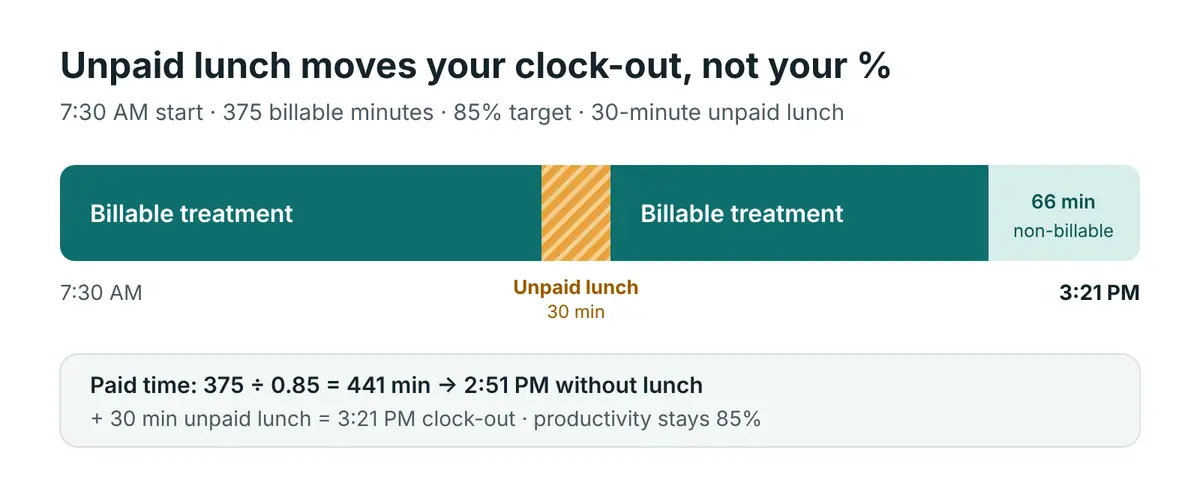
Jordan, an outpatient PT, starts at 7:30 AM with 375 billable minutes and an 85% target.
- Paid time: 375 ÷ 0.85 = 441 minutes (7 h 21 min)
- Without lunch, Jordan could leave at 2:51 PM
- Add the 30-minute unpaid lunch: clock-out at 3:21 PM
Jordan’s productivity is still 85%. The lunch didn’t hurt the number. It just added half an hour to the time spent at the clinic.
How lunch length changes your day
Same day as above (7:30 AM start, 375 billable minutes, 85% target, 441 paid minutes):
| Unpaid lunch | Clock-out time | Time at the clinic |
|---|---|---|
| None | 2:51 PM | 7 h 21 min |
| 30 minutes | 3:21 PM | 7 h 51 min |
| 45 minutes | 3:36 PM | 8 h 6 min |
| 60 minutes | 3:51 PM | 8 h 21 min |
What if your lunch is paid?
Set lunch to “paid” (or leave it at zero). A paid lunch is already inside your paid time, so it doesn’t push your clock-out later.
The catch: with a paid lunch, those 30 minutes come out of your non-billable allowance. At 85% in an 8-hour paid day, you have 72 non-billable minutes. A paid 30-minute lunch leaves 42 for notes, meetings and everything else.
Paid vs unpaid breaks: what U.S. law says
| Type of break | Typical length | Paid? | Counts in productivity math? |
|---|---|---|---|
| Rest break | 20 minutes or less | Yes, under federal law | Yes, as paid non-billable time |
| Meal period, fully off duty | About 30 minutes or more | Usually no | No, added to clock-out |
| “Lunch” while charting or answering pages | Any | Yes, it’s work time | Yes, as paid time |
- Federal law: The Department of Labor says federal law doesn’t require lunch or coffee breaks. If your employer offers short breaks, they count as paid work time. Meal periods of about 30 minutes or more are generally not work time.
- You must be completely relieved of duty. If you eat at your desk while finishing notes, that’s not a meal break, and it should be paid.
- State rules can add more. California, for example, requires a 30-minute meal period when a shift runs more than five hours, and a second one past ten hours. Check your state labor office for your rules.
Two short breaks instead of one lunch?
If your breaks are unpaid, add them together and enter the total in the lunch field. If they’re paid breaks of 20 minutes or less, leave them out. They’re already part of your paid day.
Common lunch-break mistakes that cost you time
- Subtracting lunch from billable minutes. Lunch was never billable, so don’t take it off your treatment time.
- Using 8 hours of “elapsed” time as your paid time. A 7:30–4:00 shift with a 30-minute unpaid lunch is 8 paid hours, not 8.5.
- Charting through lunch “to stay on track.” It feels efficient, but it’s unpaid work if your lunch is unpaid. Track it and talk to your manager.
Related calculators
| If you need to… | Use this |
|---|---|
| Plan a day with no lunch | Therapy Productivity Calculator |
| See how long you have left right now | Clock-Out Time Calculator |
| Check your actual productivity % today | Productivity Percentage Calculator |
Frequently asked questions
Should lunch be included in productivity?
Not an unpaid lunch. Productivity is billable minutes divided by paid minutes, and unpaid lunch is neither.
Does lunch lower my productivity percentage?
An unpaid lunch doesn’t. A paid lunch can, because it’s paid time with no billing attached.
What time do I leave with an 85% target and a 30-minute lunch?
Divide your billable minutes by 0.85, add that to your start time, then add 30 minutes. The calculator does all three steps.
Can my employer make me stay on site during an unpaid lunch?
Under federal guidance, you have to be completely relieved of duty for a meal period to be unpaid. Some states go further. In California, a required on-premises meal period has to be paid.
Does this work for a 10-hour shift?
Yes. Enter all your billable minutes and your total unpaid break time. Check your state’s rules about second meal periods on long shifts.
Plan your full day now. Use the calculator above, then save the result to your phone.
Planning tool only. Break rules vary by state and employer, so confirm yours with HR. This is not legal advice.
Sources
- U.S. Department of Labor, Breaks and Meal Periods
- U.S. Department of Labor, Fact Sheet #22: Hours Worked Under the FLSA
- California DLSE, Meal Periods FAQ
- ASHA, Productivity in Health Care Settings