
8-Minute Rule Calculator
Add each timed service you provided today and its minutes. The calculator totals your timed minutes and shows how many 15-minute units Medicare’s 8-minute rule supports, along with the minute range for that number of units.
By the Best Therapy Productivity Calculator team · Last updated October 2026
What is the 8-minute rule?
It’s Medicare’s method for turning time spent on timed outpatient therapy codes into billing units. Each unit stands for 15 minutes, and a unit can be billed once you’ve provided at least 8 minutes, just over half of 15. CMS’s outpatient therapy booklet states that a service performed for less than 8 minutes isn’t billed.
How to count:
- Add up all the timed minutes for the day
- Divide by 15 to get full units
- If 8 or more minutes remain, add one more unit
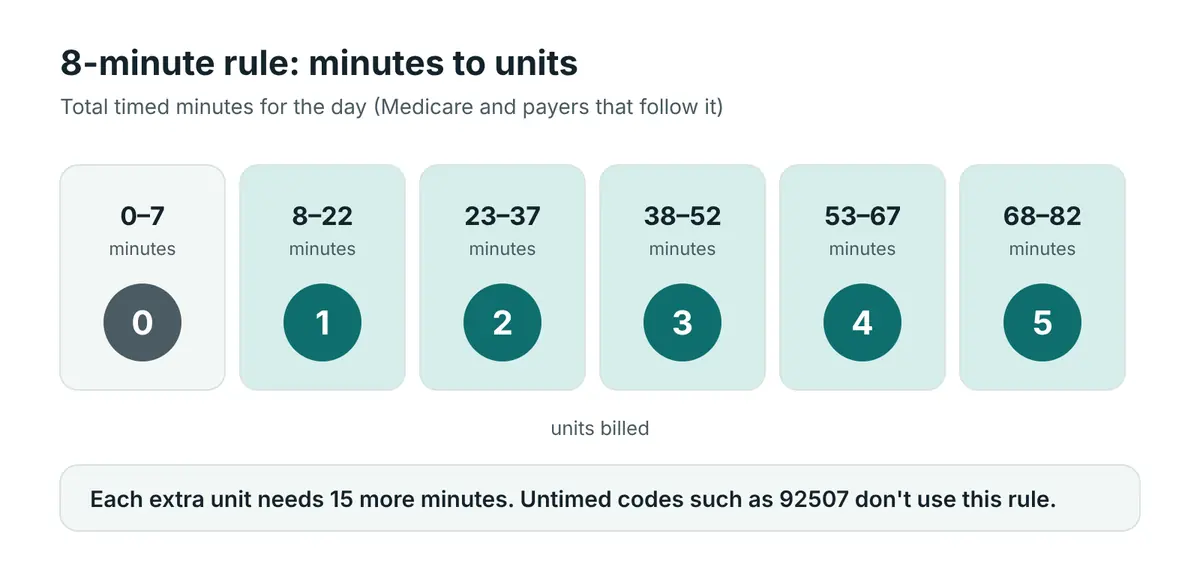
8-minute rule chart
| Total timed minutes | Units |
|---|---|
| 0–7 | 0 |
| 8–22 | 1 |
| 23–37 | 2 |
| 38–52 | 3 |
| 53–67 | 4 |
| 68–82 | 5 |
| 83–97 | 6 |
| 98–112 | 7 |
| 113–127 | 8 |
Worked examples
One timed service. 41 minutes of therapeutic exercise: 41 ÷ 15 = 2 full units with 11 minutes left. 11 is 8 or more, so you bill 3 units.
Two timed services. 20 minutes of 97110 plus 18 minutes of 97530 = 38 timed minutes, which is 3 units in total. How those 3 units are split between the two codes must follow your documentation, CMS guidance and your Medicare contractor’s instructions.
Just under the line. 37 timed minutes: 2 full units with 7 minutes left. 7 is under 8, so 2 units.
Timed vs untimed codes
| Type | Examples | How it’s billed |
|---|---|---|
| Timed (15-minute units) | Therapeutic exercise 97110, therapeutic activities 97530, self-care training 97535 | By total timed minutes, using the chart |
| Untimed (per session) | PT and OT evaluations, SLP evaluation 92506, SLP treatment 92507, group 97150 / 92508 | Once per session (often once per day), regardless of length |
Untimed minutes are never added into the 8-minute total.
The 8-minute rule and your productivity
Billing units and productivity minutes are different things. Your employer usually measures every treatment minute, while billing works in steps. A 50-minute session bills 3 units; 53 minutes bills 4. Plan sessions around the patient’s plan of care, not around unit thresholds. CMS guidance also says sessions shouldn’t be structured to consistently average less than 15 minutes per timed unit.
Payer differences
The 8-minute rule is a Medicare method. Other payers, including some commercial plans, Medicaid programs and Medicare Advantage plans, may use different unit-counting rules, so check each payer’s policy. APTA’s and ASHA’s coding pages (in the sources below) are good places to start.
Frequently asked questions
Does the 8-minute rule apply to all therapy codes?
No, only timed codes billed in 15-minute units. Evaluations and SLP treatment (92507) are untimed.
What if I provide 7 minutes of a service?
Under the Medicare 8-minute rule, a single timed service under 8 minutes isn’t billed on its own. Minutes from multiple timed services are totaled first, then converted.
How many units is 53 minutes?
4 units (53–67 minutes).
Do PTAs and OTAs follow the same rule?
Yes, for unit counting. Under Part B, their services also carry the CQ or CO modifier and are paid at 85% when they furnish more than 10% of a service’s minutes.
Related: Billing units calculator · CPT modifiers · Treatment minutes calculator
Educational tool, not billing or coding advice. Always confirm with CMS, your Medicare contractor and payer contracts.