
Documentation Time Calculator
Enter how long your notes take and how many patients you see. The calculator shows your documentation time per day, week and year, and checks it against the non-billable time your productivity target actually leaves you.
By the Best Therapy Productivity Calculator team · Last updated October 2026
How the calculation works
- Daily = minutes per note × patients per day
- Weekly = daily × workdays per week
- Yearly = weekly × working weeks per year
- Share of an 8-hour day = daily ÷ 480 × 100
- Room left under your target = (paid minutes × (1 − target)) − daily documentation
Worked example: SNF OT, 11 patients a day
Jess spends about 6 minutes per note and sees 11 patients a day, 5 days a week, for 48 working weeks a year.
| Time | |
|---|---|
| Per day | 66 minutes |
| Per week | 330 minutes (5 h 30 min) |
| Per year | 15,840 minutes (264 hours, 33 eight-hour days) |
| Share of an 8-hour day | 13.75% |
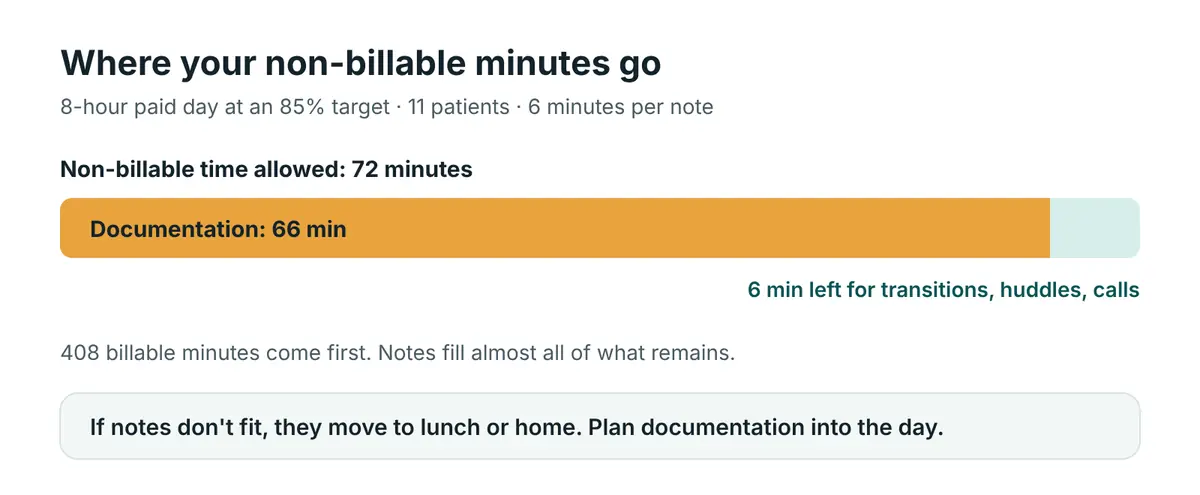
Her facility’s 85% target leaves 72 non-billable minutes in an 8-hour day. Notes alone use 66, which leaves 6 minutes for every transition, huddle and phone call. That’s why so many clinicians end up charting at lunch or at home.
How common is charting outside work hours?
In a survey of 116 U.S. physical therapists, 32% reported documenting at home, and others reported documenting during lunch or breaks. The same study found that minutes spent documenting were linked with lower job satisfaction and poorer self-reported physical and mental health.
ASHA’s 2025 survey of SLPs in health care found that only 8% said documentation counts toward productivity when the patient isn’t present.
How to cut documentation time without cutting quality
- Point-of-service notes. Enter objective data (reps, assist levels, measurements) during the session, then finish the assessment right after.
- Templates and smart phrases for repeated sections, edited for each patient, never copied blindly.
- Batch by complexity. Do quick follow-up notes in short gaps and save evaluations for a protected block.
- Track one honest week. Real numbers make the case for a schedule change better than estimates.
- Know your rights. If you’re hourly, note writing is work time. ASHA points out that the Fair Labor Standards Act protects non-exempt employees from pressure to work off the clock.
Frequently asked questions
How long should a therapy note take?
It depends on the setting, the visit type and your EMR. Evaluations take far longer than daily notes. Measure your own average for a week rather than relying on a general number.
Does documentation count toward productivity?
Only if your employer counts it. In ASHA’s 2025 survey, 8% of health care SLPs said it does when the patient isn’t present.
Is it legal to require notes after my shift?
If you’re non-exempt (hourly), time spent on notes is work time and must be paid under federal law. Talk to HR or your state labor office if it isn’t.
How many hours a year do therapists spend on documentation?
Use the calculator with your own numbers. At 6 minutes a note and 11 patients a day, it’s about 264 hours a year.
Related: Therapy productivity calculator · Productivity percentage calculator · Caseload calculator
Planning tool only. Not legal or employment advice.
Sources
- Lakeland University, Impact of Productivity Standards and Documentation Requirements on American Physical Therapists (survey of 116 PTs)
- ASHA, 2025 SLP Health Care Survey: Practice Trends 2015–2025
- ASHA, Productivity in Health Care Settings