
Clinical Educator Resources
Taking a student is good for the profession and good for patients, but it changes your day. This page is for clinical instructors, fieldwork educators, clinical fellowship mentors and program faculty. It covers how students affect productivity, the Medicare supervision rules by setting, and free ways to teach productivity math.
By the Best Therapy Productivity Calculator team · Last updated October 2026
Do students lower or raise a clinician’s productivity?
Both are possible, and it shifts over a placement. Early on, teaching, co-documenting and feedback take time that isn’t billable. Later, a capable student may carry part of a caseload under supervision, depending on the setting and payer.
Ask your manager before the placement starts:
- Is the productivity target adjusted while I have a student?
- How are student minutes credited?
- Is time for feedback and student documentation protected?
What are the Medicare rules for therapy students?
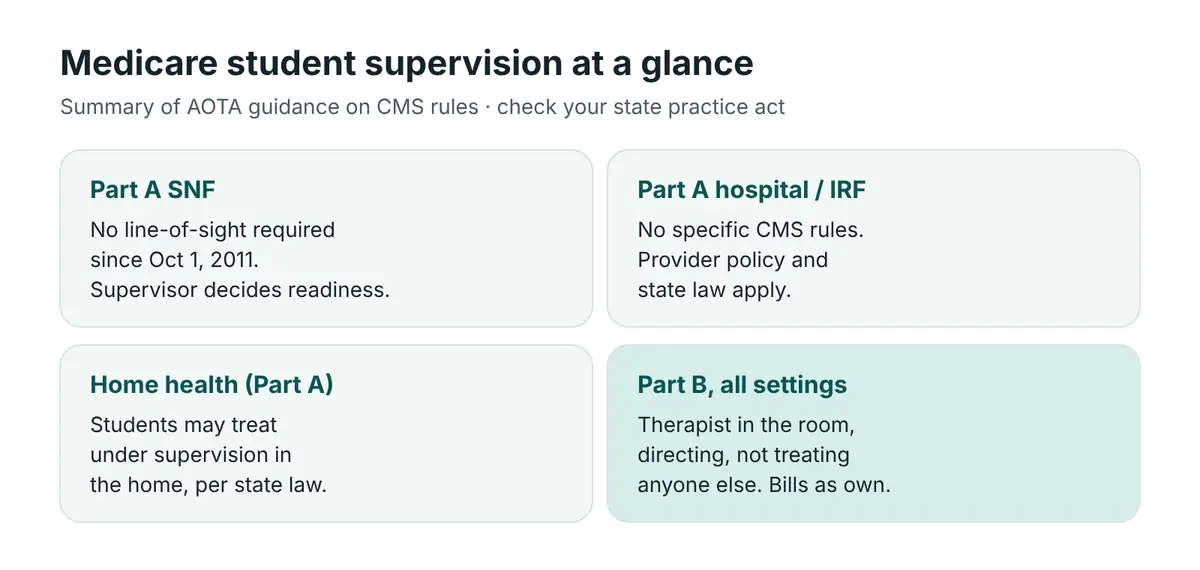
These are summarized from AOTA’s guidance on Medicare requirements for student supervision. Always check your setting, payer and state practice act.
| Setting | What Medicare says about students |
|---|---|
| Part A SNF | Line-of-sight supervision isn’t required (since October 1, 2011). The supervising clinician decides if the student is ready. Student minutes can be recorded on the MDS when the therapist provides skilled direction. |
| Part A hospital / IRF | No specific CMS student rules; providers set supervision under state law. Supervised student services can count toward the IRF 3-hour rule. |
| Home health (Part A) | No specific CMS student restrictions; students may provide services under supervision in the home, as state law allows. |
| Part B (all settings) | Only the qualified therapist’s services are billable. The therapist must be in the room, directing the service, making the skilled judgments and not treating another patient. The therapist signs all documentation. |
How do you teach productivity math to students?
Use our free calculators as a classroom exercise. Example activity:
- Give students a sample schedule: 7:30 AM to 4:00 PM, 30-minute unpaid lunch, 9 patients with session minutes.
- Have them work out paid minutes, billable minutes and productivity by hand.
- Check the answer in the therapy productivity calculator.
- Change one thing (a no-show, a 10-hour shift, a co-treat) and recalculate.
- Discuss: what is the clinical risk of chasing the number?
Pair it with the 2014 AOTA/APTA/ASHA consensus statement on clinical judgment to frame the ethics discussion.
Professional resources for educators
| Discipline | Resource |
|---|---|
| PT | APTA Credentialed Clinical Instructor Program |
| OT | AOTA fieldwork education resources, including Medicare supervision guidance |
| SLP | ASHA clinical fellowship and supervision resources |
Frequently asked questions
Can student minutes count toward my productivity?
That’s your employer’s policy. Medicare rules on billing differ by Part A and Part B, as shown above.
Does a student need line-of-sight supervision in a SNF?
Not for Part A SNF residents since October 1, 2011. The supervising therapist decides.
Can I bill Part B for a student’s treatment?
Only when you meet the Part B conditions: in the room, directing the service and not treating anyone else. The service is billed as yours.
Related: Productivity calculator examples · How to calculate therapy productivity · Editorial policy
Educational summary, not legal or billing advice.
Sources
- AOTA, OT/OTA Student Supervision & Medicare Requirements
- APTA, Consensus Statement on Clinical Judgment in Health Care Settings (AOTA, APTA, ASHA, 2014)
- APTA, Credentialed Clinical Instructor Program
- ASHA, Clinical Fellowship