
Physical Therapy Productivity Calculator
Plug in your start time, billable minutes, productivity target and typical visit length. You’ll get your clock-out time and the number of visits that schedule works out to. It’s built around how PT departments actually measure the day: minutes, percentages and visits.
By the Best Therapy Productivity Calculator team · Last updated October 2026
How do you calculate PT productivity?
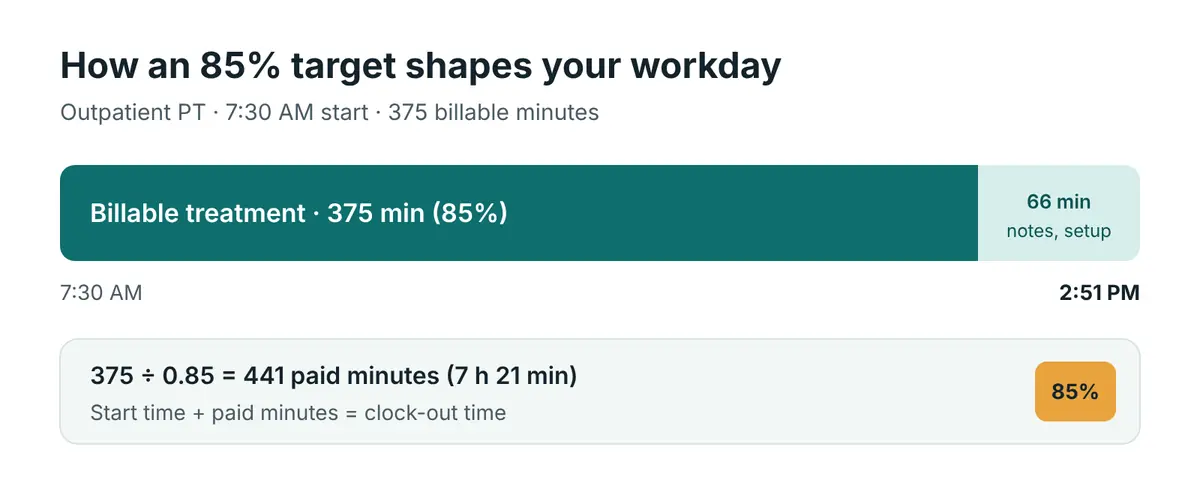
PT productivity is usually billable treatment minutes divided by paid minutes, times 100. To find your end time, flip it around.
Paid time = billable minutes ÷ (target % ÷ 100)
Clock-out = start time + paid time + any unpaid lunch
Visits = billable minutes ÷ average treatment minutes per visit
Worked example: outpatient orthopedic PT, 88% target
Dana starts at 7:00 AM with 390 billable minutes on the schedule and no unpaid lunch.
- 390 ÷ 0.88 = 443 paid minutes (7 h 23 min)
- Clock-out: 2:23 PM
- Non-billable time: 53 minutes
- With 45-minute treatment sessions, 390 minutes is about 8.7 visits, so in practice 9 patients with a couple of shorter follow-ups
How many patients does a PT see per week?
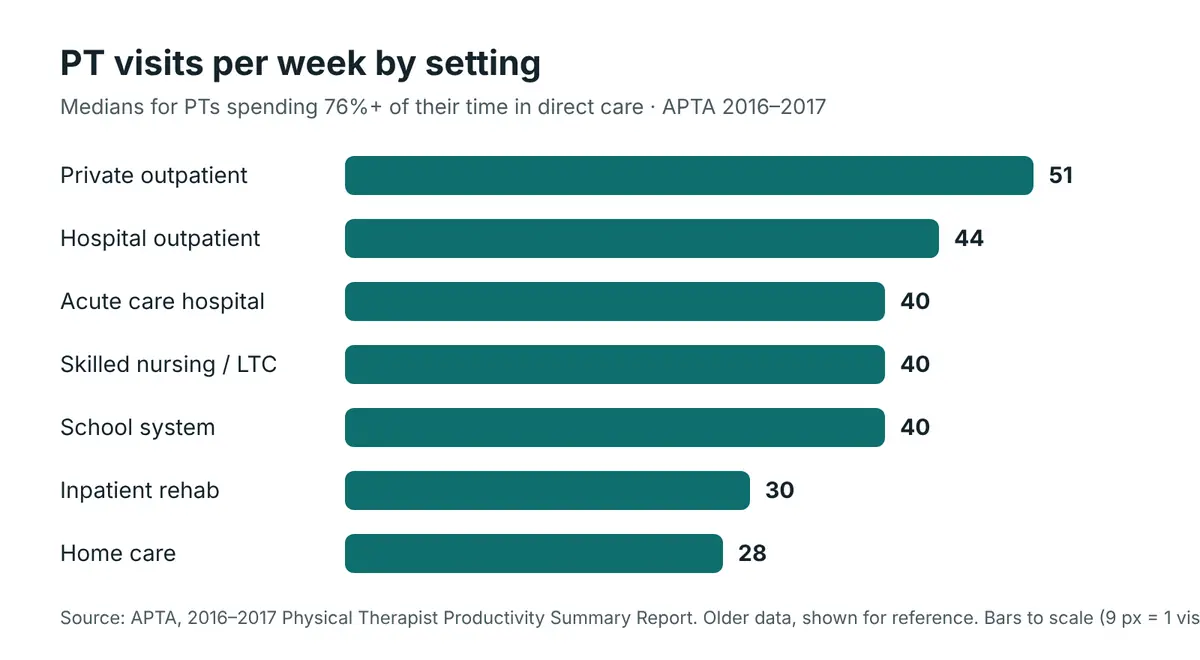
APTA’s PT Practice Profile Survey is the most detailed public source. It reports median visits per week by setting for PTs who spend most of their time in direct care. It’s from 2016–2017, so treat it as a rough reference, not a current standard.
| Setting | Visits per week (51–75% of time in direct care) | Visits per week (76%+ in direct care) |
|---|---|---|
| Private outpatient office or group practice | 40 | 51 |
| Hospital-based outpatient | 35 | 44 |
| Acute care hospital | 39 | 40 |
| Skilled nursing facility / long-term care | 35 | 40 |
| School system | 30 | 40 |
| Inpatient rehabilitation facility | 30 | 30 |
| Home care | 25 | 28 |
Source: APTA, 2016–2017 Physical Therapist Productivity Summary Report (PT Practice Profile Survey), medians per typical week.
APTA doesn’t publish a national “average productivity percentage” for PTs. If you see one quoted online without a source, be skeptical.
What PT-specific rules affect your day?
Most PT treatment codes are timed
Codes like therapeutic exercise (97110) and therapeutic activities (97530) are billed in 15-minute units. Under Medicare’s 8-minute rule, you need at least 8 minutes of a timed service to bill one unit, 23 minutes for two, and 38–52 minutes for three. Evaluations are untimed and billed once regardless of length.
This is why a PT schedule built in 15-minute blocks doesn’t always line up with billable units. A 50-minute session may support 3 units (38–52 minutes), while a 53-minute session supports 4.
PTA services are paid less under Medicare Part B
Since January 1, 2022, Medicare Part B pays 85% of the normal rate for services furnished in whole or in part by a physical therapist assistant. Those services carry the CQ modifier. The modifier applies when the PTA furnishes the whole service, or more than 10% of its minutes.
The reduced rate can affect how clinics staff and schedule PTs and PTAs, so it’s worth asking your manager how it shapes your schedule.
Your target is your employer’s choice
APTA’s House of Delegates adopted a policy in 2021 supporting productivity standards that balance patient experience and outcomes, respect clinical judgment and the APTA Code of Ethics, consider care-delivery economics, and improve the work experience of PTs and PTAs. APTA, AOTA and ASHA also issued a joint statement in 2014 saying care decisions belong to clinicians using their clinical judgment.
What is a typical PT productivity target?
There’s no official national number. In practice, the target depends on the setting and on what your employer counts. Use these questions to judge yours:
- Does documentation count? If not, every note comes out of your non-billable minutes.
- Are evaluations weighted? A 60-minute eval with 30 minutes of documentation is very different from a 30-minute follow-up.
- How are cancellations handled? In outpatient, a 10% cancellation rate can wipe out your margin if the target assumes a full schedule.
- Are PTs and PTAs held to the same target? Some employers set different targets for PTAs, since PTAs don’t do evaluations or plans of care.
For setting-specific detail, see therapy productivity benchmarks, SNF and outpatient.
Billable minutes needed at common PT targets (8-hour paid day)
| Target | Billable minutes | 45-minute visits | 30-minute visits | Non-billable minutes |
|---|---|---|---|---|
| 75% | 360 | 8 | 12 | 120 |
| 80% | 384 | 8.5 | 12.8 | 96 |
| 85% | 408 | 9.1 | 13.6 | 72 |
| 88% | 423 | 9.4 | 14.1 | 57 |
| 90% | 432 | 9.6 | 14.4 | 48 |
Common PT productivity problems, and what helps
- Evals stacked in the afternoon. You fall behind on documentation. Spread them across the day when you can.
- Cancellations you can’t fill. Track your real cancellation rate for a month and bring it to your manager. It’s a scheduling issue, not a clinical one.
- Co-signing PTA notes. That time is real work. Ask whether your facility counts supervision time.
- Charting at home. In one survey of 116 U.S. physical therapists, 32% said they document at home. If you’re hourly, unpaid off-the-clock work is a wage issue. Raise it with HR.
Related calculators
| If you need to… | Use this |
|---|---|
| Add an unpaid lunch | Productivity Calculator with Lunch Break |
| Check your actual % for today | Productivity Percentage Calculator |
| Compare with OT or SLP | OT Productivity Calculator · SLP Productivity Calculator |
Frequently asked questions
What is a good productivity percentage for a physical therapist?
There’s no official national standard. Targets vary by setting and by what your employer counts. Compare your target with your setting and your actual workload, not with a number from another clinic.
How many patients does an outpatient PT see per day?
APTA’s 2016–2017 survey found median outpatient visits of 35–51 per week, depending on setting and time in direct care. That’s roughly 7–10 visits per day over a five-day week.
Do PTAs have higher productivity targets than PTs?
Sometimes. Because PTAs don’t do evaluations or plans of care, some employers set a different target for them. Check your own facility’s policy.
Does the 8-minute rule change my productivity?
No. The 8-minute rule decides billing units under Medicare. Productivity is based on minutes, set by your employer.
Can my employer require me to treat a patient longer to hit my number?
Treatment length should follow medical necessity and your clinical judgment. APTA, AOTA and ASHA’s joint 2014 statement says care decisions belong to clinicians.
Plan your PT day. Use the calculator above, then check where your target sits in therapy productivity benchmarks.
Planning tool only. Not billing, legal or employment advice.
Sources
- APTA, 2016–2017 Physical Therapist Productivity Summary Report (PT Practice Profile Survey)
- APTA, Productivity Standards in the Physical Therapy Workforce (HOD P09-21-23-13, 2021)
- APTA, Consensus Statement on Clinical Judgment in Health Care Settings (APTA, AOTA, ASHA, 2014)
- CMS, Billing Examples Using CQ/CO Modifiers
- CMS, Outpatient Rehabilitation Therapy Services (MLN905365)
- CMS, Coding Guidelines: Therapy and Rehabilitation Services
- Lakeland University, survey of 116 U.S. physical therapists