
Concurrent vs Group Therapy: What’s the Difference?
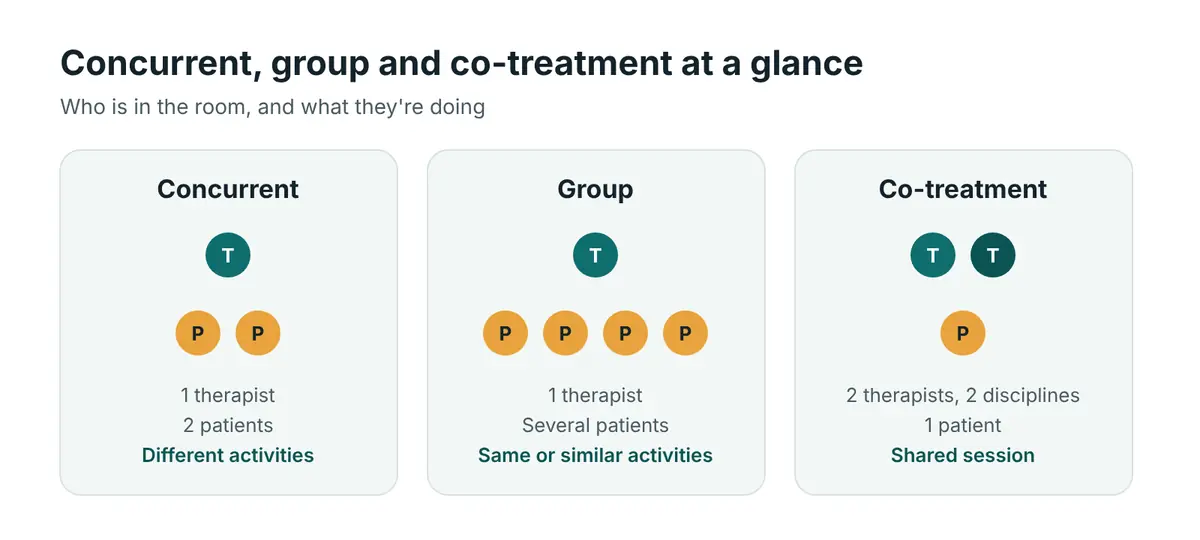
Concurrent therapy is one therapist treating two patients at the same time, each doing a different activity. Group therapy is one therapist treating several patients doing the same or similar activities. Co-treatment is two therapists from different disciplines treating one patient together. Medicare treats all three differently, and the rules depend on whether the patient is in a SNF Part A stay or outpatient Part B.
By the Best Therapy Productivity Calculator team · Last updated October 2026
Side-by-side comparison
| Concurrent | Group | Co-treatment | |
|---|---|---|---|
| Therapists | 1 | 1 | 2 (different disciplines) |
| Patients | 2 | Several | 1 |
| Activities | Different | Same or similar | Shared session |
| SNF Part A (PDPM) | Counts toward the combined 25% limit | Counts toward the combined 25% limit | Each discipline’s time is recorded per facility and MDS rules |
| Outpatient Part B | Billed as group (97150) unless one-on-one time is tracked | Billed as group: 97150 (PT/OT), 92508 (SLP) | Payer rules apply; check before billing |
SNF Part A: the PDPM rules
Under Medicare’s Patient Driven Payment Model, in effect since October 1, 2019:
- Concurrent: one therapist, two patients, different activities
- Group: one therapist, a small group, same or similar activities
- Concurrent and group together are capped at 25% of therapy minutes, for each discipline
- Compliance is tracked on the resident’s PPS discharge assessment (item O0425)
Before PDPM, the old RUG-IV system capped only group therapy at 25% and didn’t limit concurrent therapy.
Outpatient Part B: what CMS says
CMS’s Part B billing guidance for PTs and OTs explains:
- If a therapist divides attention between patients, gives only brief, intermittent contact, or gives the same instructions to two or more patients at once, each patient is billed one unit of 97150 (group, untimed)
- If direct one-on-one time is tracked separately, those minutes can be billed as individual timed services
- Timed codes and 97150 can’t be billed in the same 15-minute period
- Group and individual services on the same day are possible if both sets of rules are met. The group session must be distinct, and it’s billed with modifier 59, subject to NCCI edits.
For SLPs, group treatment is reported with 92508.
Why it matters for your productivity
Billing rules and productivity rules are separate. Your employer decides how concurrent and group minutes count toward your number: clock minutes, a split, or patient minutes. See how much difference that makes with the concurrent therapy calculator.
When concurrent or group treatment is appropriate
The decision should be clinical, based on each patient’s goals and needs, not on a productivity target. APTA, AOTA and ASHA’s joint 2014 statement says care decisions should be made by clinicians using their clinical judgment.
Frequently asked questions
Is concurrent therapy the same as group therapy?
No. Concurrent means two patients doing different activities with one therapist. Group means several patients doing the same or similar activities.
Can Medicare Part B patients receive concurrent therapy?
Part B has no separate “concurrent” billing category. Per CMS guidance, simultaneous treatment without one-on-one contact is billed as group therapy (97150).
What counts toward the PDPM 25% limit?
Concurrent and group minutes combined, measured separately for each discipline.
Is co-treatment the same as concurrent therapy?
No. Co-treatment is two therapists with one patient. Concurrent is one therapist with two patients.
Related: Concurrent therapy calculator · SNF benchmarks · CPT modifiers for therapy
Not billing advice. Confirm current rules with CMS, your Medicare contractor and your compliance team.
Sources
- CMS, SNF PPS: Patient Driven Payment Model (MLN presentation)
- CMS, FY 2019 SNF payment and policy changes
- CMS, 11 Part B Billing Scenarios for PTs and OTs
- CMS, Coding Guidelines: Therapy and Rehabilitation Services
- APTA, Consensus Statement on Clinical Judgment (APTA, AOTA, ASHA, 2014)