
CPT Modifiers for Therapy: A Plain-English Guide
Modifiers are two-character codes added to a CPT code to tell the payer something extra: which discipline delivered the service, whether an assistant was involved, whether a threshold has been passed. Getting them wrong is one of the fastest routes to a denied claim. This page covers the Medicare modifiers therapists see most, with the 2026 figures from CMS.
By the Best Therapy Productivity Calculator team · Last updated October 2026
Quick reference table
| Modifier | Meaning | Who uses it |
|---|---|---|
| GP | Services under a physical therapy plan of care | PT, PTA |
| GO | Services under an occupational therapy plan of care | OT, OTA |
| GN | Services under a speech-language pathology plan of care | SLP |
| KX | Medical necessity documented; services above the annual threshold | PT, OT, SLP |
| CQ | Service furnished in whole or in part by a PTA | PTA |
| CO | Service furnished in whole or in part by an OTA | OTA |
| 59 | Distinct procedural service | All |
| XE / XS / XP / XU | More specific versions of 59 | All |
| GA | Waiver of liability (ABN) on file | All |
| GZ | ABN expected denial, no ABN on file | All |
| GY | Statutorily excluded or not a Medicare benefit | All |
| GX | Voluntary ABN issued for a non-covered service | All |
What are the GP, GO and GN modifiers?
They tell Medicare which therapy plan of care the service belongs to. Every outpatient therapy line billed to Medicare needs one. A service like therapeutic exercise (97110) can be delivered by PT or OT, so the modifier is what separates them.
What is the KX modifier threshold for 2026?
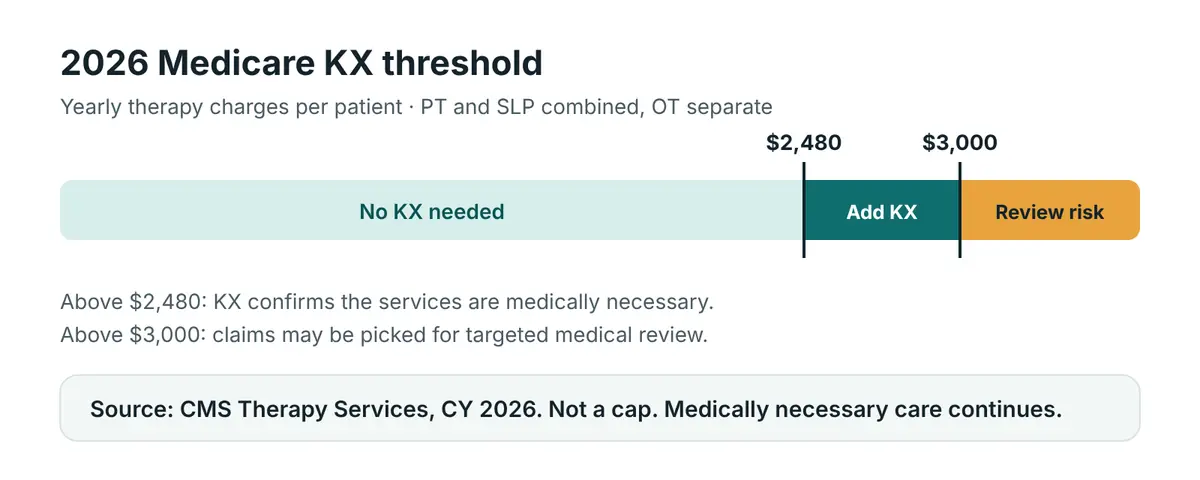
For calendar year 2026, CMS set the KX modifier threshold at $2,480 for PT and SLP services combined, and a separate $2,480 for OT services.
- Below the threshold, no KX is needed
- Above it, you add KX to confirm the services are medically necessary and that the record supports it
- Claims above the threshold without KX are denied
- Above $3,000 (PT and SLP combined, or OT), claims may be selected for targeted medical review
The old “therapy cap” is gone. The threshold is not a hard limit. It’s a point where you must attest medical necessity.
What do the CQ and CO modifiers do to payment?
They flag services furnished in whole or in part by a physical therapist assistant (CQ) or occupational therapy assistant (CO). Since January 1, 2022, Medicare pays these services at 85% of the fee schedule amount.
CQ or CO applies when the assistant furnishes more than 10% of the service (the de minimis standard). CMS added two rounding exceptions in 2022:
| Situation | How to bill |
|---|---|
| One 15-minute unit left, and the PT or OT furnished at least 8 minutes of it | Bill that unit without CQ/CO |
| Two units left, the therapist and assistant each furnished 9–14 minutes, and the combined time is 23–28 minutes | One unit with CQ/CO, one without |
CQ and CO go with GP or GO, never instead of them.
When do you use modifier 59 or an X modifier?
When two procedures that normally aren’t billed together were truly separate on the same day. National Correct Coding Initiative (NCCI) edits pair certain codes, such as 97140 (manual therapy) with 97530 (therapeutic activities). If the services were done in separate, distinct time intervals, a modifier can show that.
The X modifiers are more specific than 59:
- XE: separate encounter
- XS: separate structure or organ
- XP: separate practitioner
- XU: unusual non-overlapping service
Check your payer’s policy. Some prefer X modifiers; others still accept 59.
What are the GA, GZ, GY and GX modifiers?
They relate to the Advance Beneficiary Notice (ABN), the form that tells a Medicare patient a service may not be covered.
- GA: an ABN was signed and is on file
- GZ: you expect a denial and no ABN was signed (the patient generally can’t be billed)
- GY: the service is excluded by law or isn’t a Medicare benefit
- GX: a voluntary ABN was given for a service that’s never covered
Common modifier mistakes
- Missing the discipline modifier (GP/GO/GN) on a line
- Forgetting KX after the threshold is passed, which leads to denial
- Leaving off CQ/CO when the assistant furnished more than 10% of the minutes
- Using 59 to bypass an edit when the services weren’t truly distinct
- Using GA without a valid, signed ABN
Frequently asked questions
Do commercial payers use these modifiers?
Many follow Medicare’s lead on GP, GO and GN, but rules vary. Check each payer’s policy.
Is the KX threshold per discipline?
PT and SLP share one threshold. OT has its own.
Does the $3,000 review threshold change?
CMS says the $3,000 targeted medical review amount stays the same through 2027 and is indexed starting in 2028.
Does CQ/CO apply in a SNF Part A stay?
No. The CQ and CO payment reduction applies to Part B services paid under the physician fee schedule.
Related: 8-minute rule calculator · Therapy billing units calculator · Treatment minutes calculator
Educational content only, not billing or legal advice. Confirm with CMS, your MAC and your payer contracts.