
Concurrent Documentation in Therapy
Concurrent documentation (also called point-of-service documentation) means writing your note during the session or in the minutes right after it, rather than after your last patient. Done well, it saves time and improves accuracy. Done badly, it pulls your attention off the patient. It’s different from concurrent therapy, which means treating two patients at once.
By the Best Therapy Productivity Calculator team · Last updated October 2026
Why does it save time?
You remember the session best right after it. A note written then takes less time than one rebuilt from memory at 5 PM, and it’s more accurate. It also stops notes from piling up into unpaid time. In the Lakeland survey of 116 PTs, 32% said they documented at home.
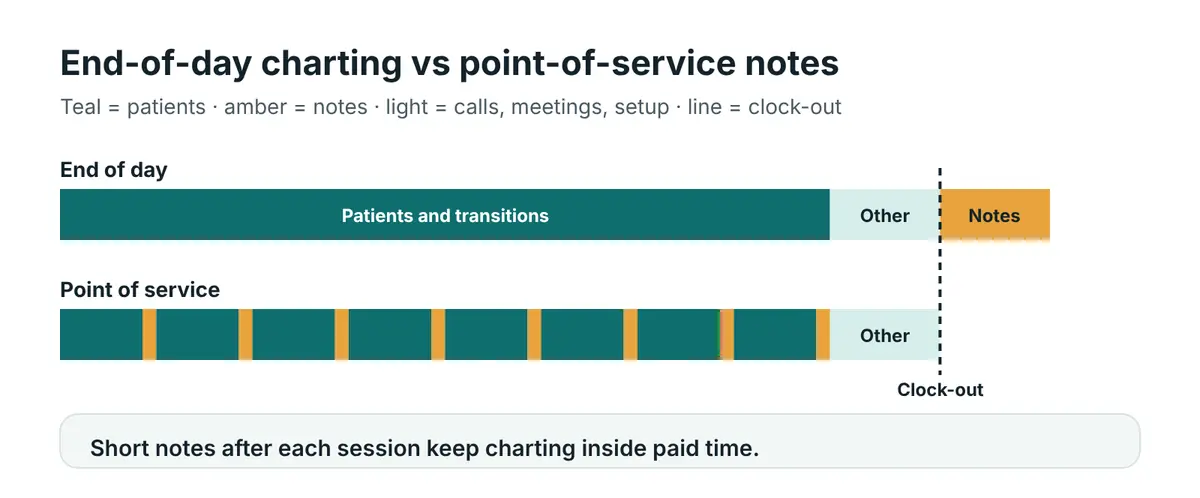
How do you document during a session without hurting care?
| Do | Don’t |
|---|---|
| Record measurements as you take them (ROM, reps, assist level) | Type while the patient is doing something unsafe |
| Use the last 2–3 minutes to review the plan with the patient while you write | Turn your back on the patient for long stretches |
| Use a tablet or laptop on a stand, facing the patient where possible | Let the device become the focus of the session |
| Finish the narrative right after the session | Leave the whole note for the end of the day |
Does documentation time count as treatment time?
Generally, no. Time spent documenting while not treating the patient isn’t direct treatment time, so it usually doesn’t count toward billed minutes. Recording data while you’re actively treating is part of the session. If you’re unsure, follow your payer’s rules and your facility’s compliance guidance, and don’t count note-writing minutes as treatment.
What about collaborative documentation?
Some practices write parts of the note with the patient, such as goals or their own report of progress. It can improve engagement. Make sure it fits your setting, your patient and your employer’s policy.
Frequently asked questions
Is point-of-service documentation the same as concurrent documentation?
Yes, the terms are used interchangeably.
Will it lower my productivity?
Not if note-writing happens in transition time or in the last minutes after treatment ends. It may raise it by freeing up your end-of-day block.
Is it allowed in every setting?
Most settings allow it. Check your employer’s policy on devices in treatment areas.
Related: Documentation time calculator · Between-session transition routine · AI for therapy notes
Sources
- Lakeland University, Impact of Productivity Standards and Documentation Requirements on American Physical Therapists (survey of 116 PTs)