
Unrealistic Productivity Standards in Healthcare: A PT, OT and SLP Guide to Pushing Back
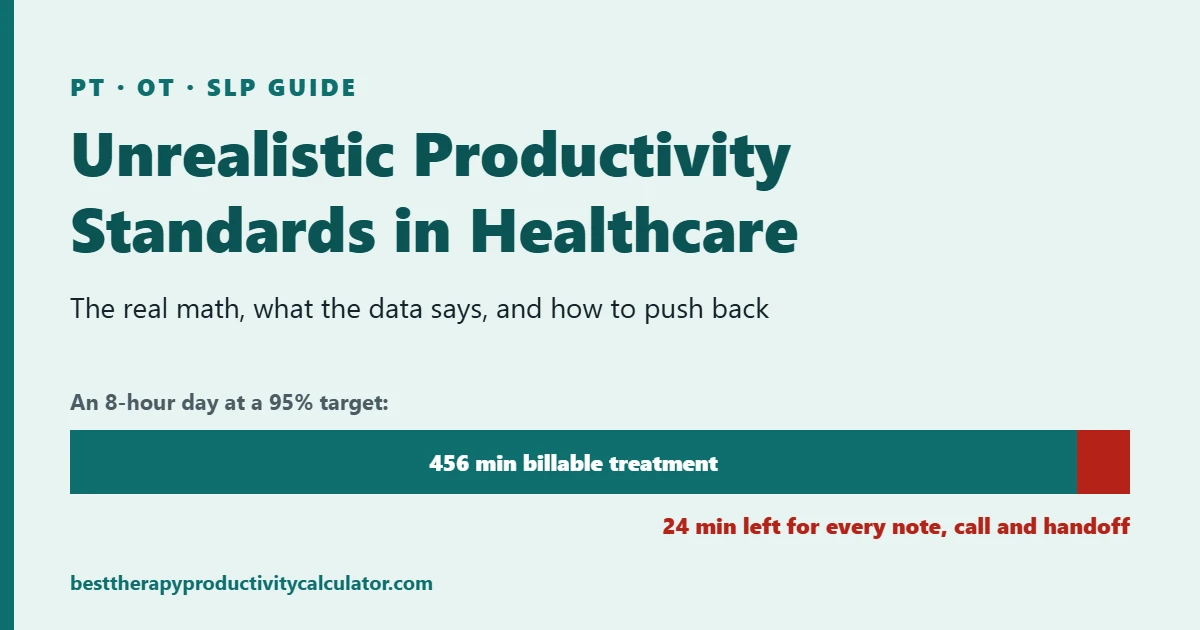
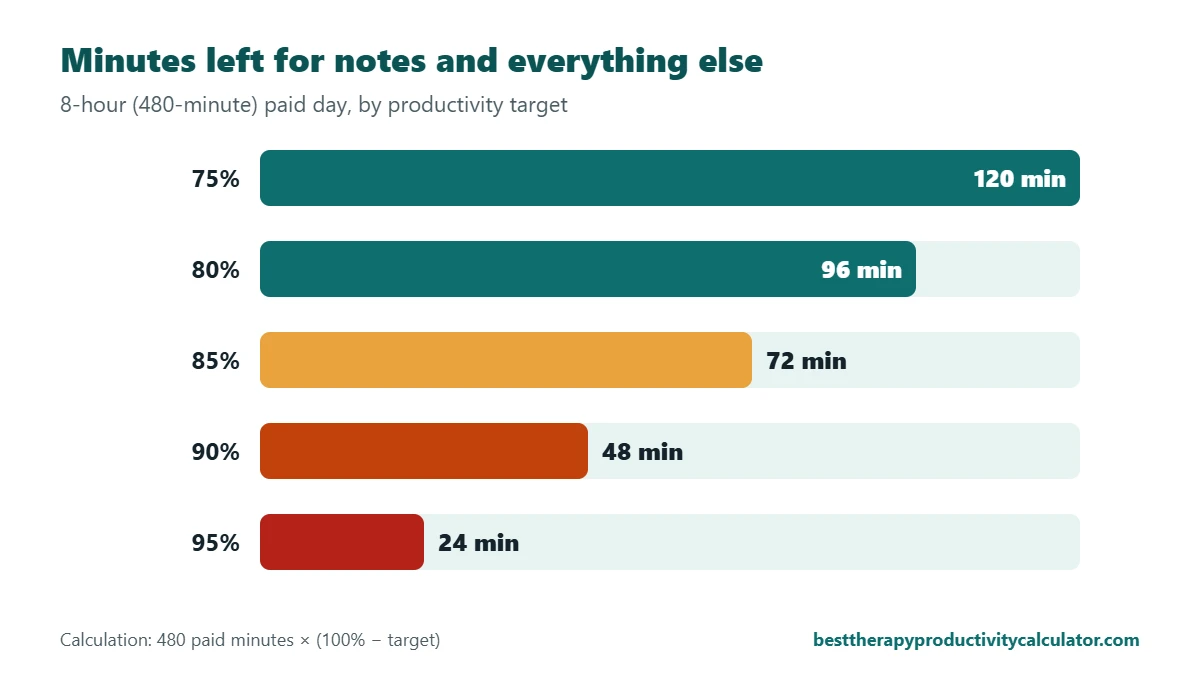
Unrealistic productivity standards in healthcare are targets that can’t be met without cutting care, charting off the clock, or billing time that shouldn’t be billed. For physical therapists, occupational therapists and speech-language pathologists, the warning sign is simple math: at a 90% target in an 8-hour day, you have 48 minutes for every note, phone call, handoff and setup. At 95%, you have 24.
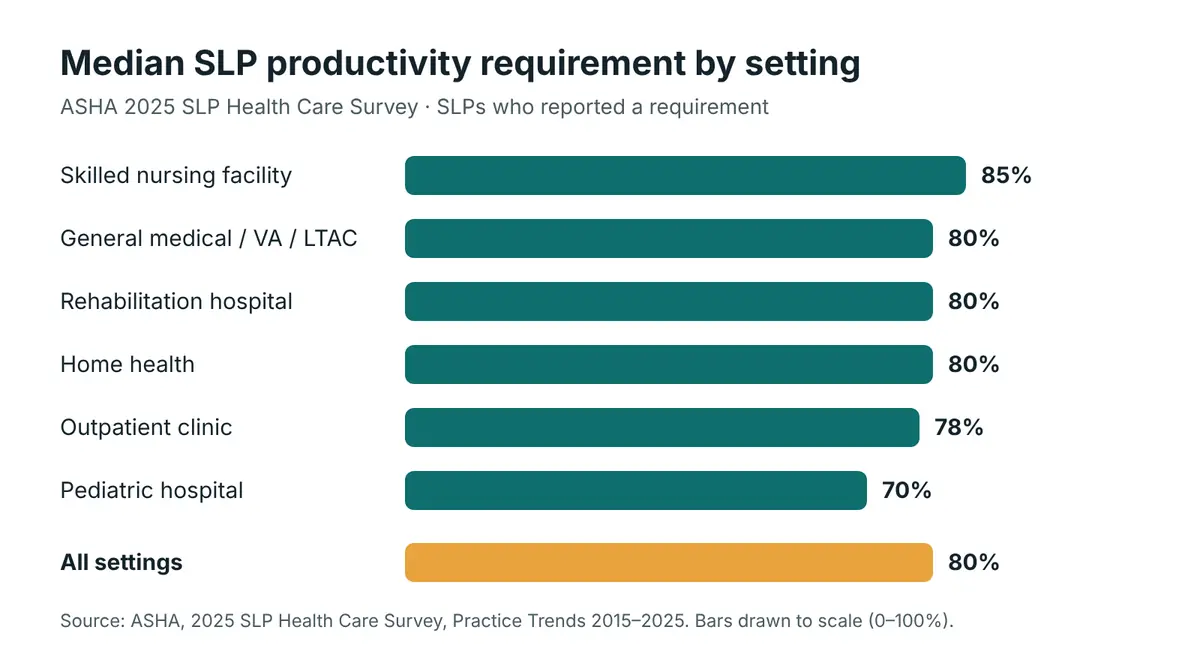
There’s no national standard. Employers set their own targets. The best public data comes from ASHA’s 2025 survey, where the median requirement for SLPs was 80% across all settings and 85% in skilled nursing facilities. In the same survey, 42% of SLPs named productivity demands or lack of time as a top barrier to good care.
This guide shows how to check whether your target is fair, what the professional associations say, and a step-by-step way to push back without putting your job at risk.
Key takeaways
- Productivity = billable minutes ÷ paid minutes. Your employer decides what counts. Payers don’t set productivity standards.
- The typical target is about 80%. ASHA’s 2025 survey found a median of 80% overall and 85% in SNFs. Targets of 90% or higher leave less than an hour a day for everything that isn’t treatment.
- High targets are linked to real harm. In SNFs, 22% of SLPs reported pressure to provide therapy at an inappropriate frequency or intensity, and 26% reported pressure to discharge patients inappropriately (ASHA, 2025).
- Your clinical judgment comes first. APTA, AOTA and ASHA all say productivity targets must not override medical necessity or ethics.
- Push back with numbers, not feelings. Track two weeks of time, run the math, propose a fix in writing.
What are unrealistic productivity standards in healthcare?
A productivity standard is the share of your paid time you’re expected to spend in billable patient care. Most employers use this formula:
Productivity % = billable (or direct-care) minutes ÷ paid minutes × 100
A standard becomes unrealistic when the time it leaves over is smaller than the work you’re required to do outside of treatment. That work includes documentation, care coordination, family training, team meetings, equipment setup, walking patients to the gym, and travel between buildings or homes.
ASHA points out that employers decide which activities count. Many count only billable time, so required tasks like documentation simply disappear from the math. That’s how a target can look reasonable on paper and still force clinicians to finish notes at home.
Other signs a target has crossed the line:
- No-shows and late cancellations count against you, even though you can’t control them
- Evaluations, re-evaluations and complex patients are treated the same as routine visits
- You’re told to overbook, “find more minutes,” or discharge patients who aren’t attending
- The target was raised without any change in staffing, schedule or patient mix
Productivity standards for PT, OT and SLP: what the data shows
There’s no single national benchmark, and anyone quoting one should show a source. Here’s what the published data actually says.
| Measure | Figure | Source |
|---|---|---|
| SLPs with a productivity requirement | 60% overall, 92% in SNFs | ASHA 2025 SLP Health Care Survey |
| Median SLP requirement, all settings | 80% (mean 79%) | ASHA 2025 |
| Median SLP requirement, SNF / subacute | 85% | ASHA 2025 |
| Median SLP requirement, rehab hospital | 80% | ASHA 2025 |
| Median SLP requirement, pediatric hospital | 70% | ASHA 2025 |
| Mean requirement, salaried vs hourly/per-visit SLPs | 76% vs 81% | ASHA 2025 |
| PTs working at or above capacity | About 72% | APTA 2025 Physical Therapy Profile Survey |
| National PT shortfall | About 12,070 full-time equivalents | APTA 2024 Workforce Survey |
Physical therapy productivity expectations
APTA doesn’t publish a recommended percentage. Its House of Delegates policy (HOD P09-21-23-13) says productivity standards should balance patient outcomes, the therapist’s clinical judgment, the APTA Code of Ethics, the economics of the care model, and the provider’s work experience. In outpatient settings, physical therapy productivity expectations are often measured as visits per day or units per hour instead of a percentage. Use our physical therapy productivity calculator and visits per hour calculator to compare your numbers.
Occupational therapy productivity standards
AOTA also doesn’t set a target. It offers members a Productivity Decision Guide to help practitioners understand how productivity is calculated and advocate for fair occupational therapy productivity standards. OT adds its own wrinkles: co-treatment crediting, ADL sessions that start before the patient is up, and OTA supervision rules. Our OT productivity calculator lets you choose how co-treat minutes are credited.
Speech therapy productivity requirements
ASHA has the best data of the three associations, but it doesn’t recommend a percentage either. It reports what SLPs say their employers require. Speech therapy productivity requirements are highest in SNFs and lowest in pediatric hospitals. Per-visit and hourly SLPs face higher averages (81%) than salaried SLPs (76%). See the full picture on our SLP productivity calculator and benchmarks page.
How to tell if your target is unrealistic: run the math
The fastest test: subtract your billable minutes from your paid minutes, then compare what’s left with the time your non-billable work really takes.
| Target | Billable minutes (8-hour day) | Minutes left for everything else | Per patient, if you see 8 |
|---|---|---|---|
| 75% | 360 | 120 | 15 min |
| 80% | 384 | 96 | 12 min |
| 85% | 408 | 72 | 9 min |
| 90% | 432 | 48 | 6 min |
| 95% | 456 | 24 | 3 min |
Now add your documentation. In the worked example on our documentation time calculator, notes take 66 minutes a day. At 85%, that leaves 6 minutes for phone calls, handoffs and setup. At 90%, you’re already 18 minutes short, so the only options are charting off the clock, charting during treatment, or missing the target.
No-shows make it worse. If 2 patients cancel late (two 45-minute sessions), an 80% day drops from 384 to 294 billable minutes. That’s 61.3%, even though you were ready to work the whole time. If no-show time were removed from paid minutes, the same day would score 294 ÷ 390 = 75.4%. Ask how your employer treats cancellations. It changes everything.
| Sign | Probably fair | Warning sign |
|---|---|---|
| Target level | 75–85%, set for your setting | 90% or higher with no adjustments |
| Documentation | Some note time is built into the schedule | Notes expected to fit in the gaps |
| No-shows | Excluded, or the schedule is backfilled | Counted against you |
| Evaluations | Adjusted target or extra time | Same target as routine visits |
| Off-the-clock work | Never expected | “Everyone finishes notes at home” |
| Consequences | Coaching and schedule fixes | Write-ups or improvement plans based only on numbers |
Why unrealistic productivity standards in healthcare are a real risk
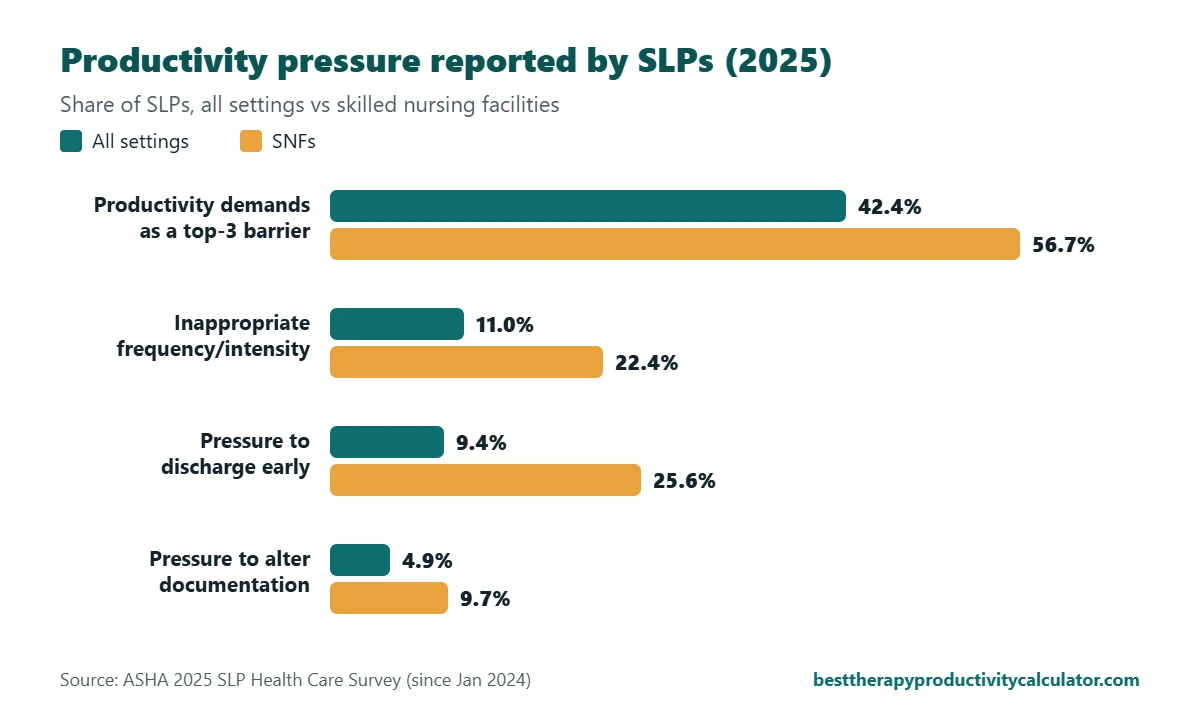
For patients. ASHA’s 2025 survey asked SLPs about pressure from employers since January 2024:
| Pressure reported (since Jan 2024) | All settings | SNFs |
|---|---|---|
| Productivity demands / lack of time as a top-3 barrier to care | 42.4% | 56.7% |
| Pressure to provide inappropriate frequency or intensity | 11.0% | 22.4% |
| Pressure to discharge inappropriately | 9.4% | 25.6% |
| Pressure to alter documentation for reimbursement | 4.9% | 9.7% |
| Daily off-the-clock work | 19% (37% of per-visit SLPs) | — |
For your license. The joint APTA, AOTA and ASHA Consensus Statement on Clinical Judgment in Health Care Settings (2014) says care decisions must rest on the clinician’s judgment. It warns that productivity quotas or administrative mandates that override that judgment can break payer rules and state licensure laws. Your license is yours, not your employer’s.
For employers. The federal government has recovered large settlements over therapy driven by billing targets instead of patient need. In 2016, Kindred’s RehabCare agreed to pay $125 million, and Life Care Centers of America agreed to pay $145 million, to resolve allegations that patients were placed in the highest therapy levels without clinical need. These were settlements, not findings of guilt, but they show where pressure can lead.
For you. About half of US physical therapists report burnout, according to a national survey cited by APTA, and about 72% work at or above capacity. Unrealistic targets push good clinicians out of the field.
How to push back on unrealistic productivity expectations: 6 steps
1. Track two weeks of real time
Log every block: treatment, documentation, evaluations, phone calls, meetings, travel, no-shows and waiting. Short tasks add up. Note any day the target forced a care decision you weren’t comfortable with. Real numbers beat estimates in every conversation.
2. Run your own numbers
Plug your schedule into our productivity calculator and productivity pace calculator. Calculate your rate two ways: as your employer measures it, and with no-shows and required non-billable tasks removed from paid time. The gap between the two numbers is your case.
3. Know the documents you can cite
- APTA, AOTA and ASHA’s Consensus Statement on Clinical Judgment (2014)
- APTA’s policy on productivity standards (HOD P09-21-23-13)
- Your association’s code of ethics
- Your state practice act
- ASHA’s productivity advocacy tools, including its note that the Fair Labor Standards Act protects non-exempt employees from unpaid work
4. Propose a fix, not just a complaint
Managers respond better to options. Ask for one or two specific changes (see the table below), and explain how each one protects billing compliance and patient outcomes, not only your time.
5. Put it in writing
After any meeting, send a short email summarizing what was discussed and agreed. If you’re asked to do something that conflicts with your clinical judgment, ask for the request in writing. Never alter documentation or bill time you didn’t provide.
6. Escalate if you need to
If nothing changes, talk to your compliance officer or HR. Reach out to your state association or national association for guidance. If you see a billing or care practice that seems improper, the Consensus Statement points to compliance channels and, if needed, reporting to the HHS Office of Inspector General or CMS. If off-the-clock work is expected, an employment attorney or your state labor office can explain your rights.
A script for talking to your manager
“I want to keep hitting our goals and keep our documentation clean. I tracked my time for two weeks. I’m averaging [X]% as we measure it, but [Y] minutes a day go to no-shows and required tasks that don’t count, like notes and care coordination. At our current target, that leaves [Z] minutes for documentation, so notes are spilling past my shift. Could we look at [excluding late cancellations / building 30 minutes of note time into the schedule / adjusting the target on evaluation days]? I’m happy to review the numbers together in a month.”
Keep it calm, specific and focused on patients and compliance. Bring your printed log.
What to ask for instead
| Ask | Why it’s reasonable |
|---|---|
| Exclude late cancellations and no-shows from paid time, or backfill the slot | You can’t bill a patient who isn’t there |
| Count required non-billable tasks (notes, care coordination, family training) | ASHA encourages employers to count activities required for care |
| Lower target or extra time on evaluation days | Evaluations take longer and pay differently |
| Scheduled documentation time | Cuts off-the-clock work and late notes |
| Weekly or monthly averages instead of daily targets | One bad day of cancellations shouldn’t trigger a write-up |
| Point-of-care documentation tools or support staff | Saves minutes without rushing treatment |
Healthcare productivity pressure in 2026: what’s changing
- Medicare payment: in the 2027 Physician Fee Schedule proposed rule (July 2026), CMS proposed a 1.68% cut to the conversion factor, while estimating a 1–3% overall increase for physical therapy codes. Tight margins often get passed to clinicians as higher targets.
- Staffing shortages: with about 72% of PTs at or above capacity, every open position adds pressure on the people who stay.
- AI documentation tools: AI scribes built for rehab therapy launched in 2026. They may cut note time, but check your employer’s HIPAA rules first. See our guide to AI for therapy notes and HIPAA.
Healthcare productivity pressure isn’t going away, which makes clear numbers and a calm, documented approach more valuable than ever.
Tools to check your numbers
- Therapy productivity calculator: find your clock-out time for any target
- Productivity percentage calculator: check today’s percentage
- Weekly therapy productivity calculator: see your weekly average
- Documentation time calculator: measure what notes really cost you
- How to reduce therapy no-shows: protect your schedule
Frequently asked questions
What is a realistic productivity standard for therapists?
There’s no national standard, but ASHA’s 2025 survey found a median of 80% for SLPs across settings, with 85% in skilled nursing facilities and 70% in pediatric hospitals. Many clinicians and practice leaders consider 75–85% workable when documentation time and no-shows are handled fairly. Above 90%, very little time is left for required non-billable work.
Are therapist productivity requirements legal?
Yes, employers may set therapist productivity requirements. But a target can’t require you to bill for care that isn’t medically necessary, alter documentation, or work unpaid if you’re a non-exempt employee. The APTA, AOTA and ASHA Consensus Statement says productivity mandates must not override clinical judgment.
Does Medicare set productivity standards for PT, OT and SLP?
No. Medicare and other payers don’t set productivity standards. Employers set them. Medicare rules control what can be billed, such as medical necessity and the 8-minute rule, which is why billing to hit a target can create compliance risk.
Should no-shows count against my productivity?
Ideally, no. A late cancellation can drop an 80% day to about 61% even though you were ready to work. Fair systems exclude no-show time from paid minutes, backfill the slot, or measure productivity as a weekly average.
Can I be fired for not meeting a productivity standard?
In most US jobs, an employer can discipline or let go of an employee for not meeting a reasonable work standard. That’s why it helps to raise concerns early, with data, in writing. If you’re asked to do something unethical or illegal to meet a target, talk to compliance, your association or an employment attorney.
What should I say in a job interview about productivity?
Ask what the target is, how it’s calculated, whether documentation and no-shows count, how evaluations are handled, and what happens when someone misses it. A clear, written answer is a good sign. A vague one is a warning.
Sources
- ASHA, 2025 SLP Health Care Survey: Practice Issues
- ASHA, 2025 SLP Health Care Survey: Practice Trends 2015–2025
- ASHA, Productivity: Advocacy Tools for Health Care SLPs and SLPAs
- APTA, AOTA and ASHA, Consensus Statement on Clinical Judgment in Health Care Settings (2014)
- APTA, Productivity Standards in the Physical Therapy Workforce (HOD P09-21-23-13)
- APTA, Proposed 2027 Medicare Physician Fee Schedule: What PTs Need to Know (July 2026)
- Physitrack, Physical Therapist Burnout Statistics (citing APTA 2024 and 2025 surveys)
- Fierce Healthcare, Kindred Healthcare pays $125M to settle claims against subsidiary
- Fierce Healthcare, Life Care pays $145 million in record-setting settlement over therapy billing
This article is for education only. It isn’t legal, billing or employment advice. Check your employer’s policies, your state practice act and your payers’ rules for your situation.